F1 2026 101: The Ultimate Guide to the New Era
The 2026 F1 era is officially here. From the "Nimble Car" chassis and high-stakes "Boost" strategy to the major leadership shakeups at Red Bull and Aston Martin, here is your ultimate guide to the new season.
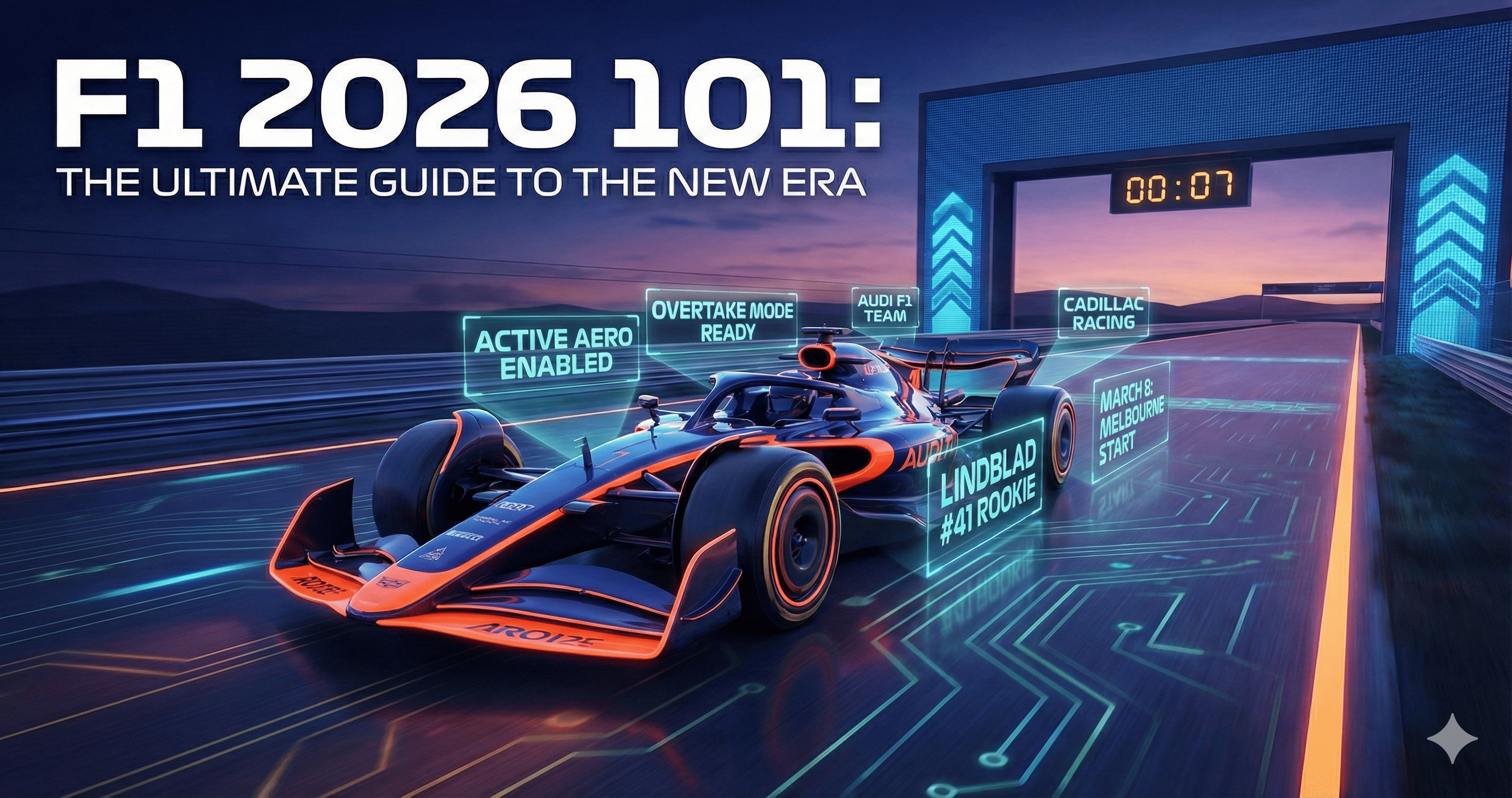
The 2025 season concluded with a historic McLaren title, but as we enter January 2026, that era is already ancient history. Formula 1 has undergone a total "hard reset." With new teams, a radical car design, and a completely new tactical vocabulary, the 2026 season is the most unpredictable in a generation.
Before you lock in your first GridPlay predictions, here is the essential 101 guide to the rules, the grid, and the tech of F1 2026.
1. Key Dates: The Road to Melbourne
We are currently in the middle of a frantic launch and testing window. Here is the complete calendar for the start of the 2026 era:
Car Launches
- January 15: Red Bull & Racing Bulls (Detroit) — Unveiled
- January 19: Haas (Online) — Unveiled
- January 20: Audi (Berlin) & Honda Engine Launch (Tokyo) — Unveiled
- January 22: Mercedes (Digital Renders)
- January 23: Ferrari (Fiorano) & Alpine (Barcelona)
- February 2: Mercedes (Full Season Track Launch)
- February 3: Williams
- February 8: Cadillac (Super Bowl Reveal)
- February 9: Aston Martin & McLaren
Testing & Racing
- January 26–30: Barcelona Shakedown (Private, non-televised test)
- February 11–20: Bahrain Pre-Season Testing (The real form guide)
- March 8: The Australian GP (The Season Opener)
2. Teams & Lineups: What’s New for 2026?
The grid has expanded to 11 teams and 22 drivers. Here are the major changes since the end of 2025:
- Cadillac F1: The American giant joins the grid as an 11th team. They have opted for pure experience, pairing Sergio Perez with Valtteri Bottas.
- Audi F1 Team: The Sauber name is gone. Audi is now a full works entry with Nico Hulkenberg and Gabriel Bortoleto.
- The British Star: In the biggest seat swap of the winter, 18-year-old British sensation Arvid Lindblad replaces Yuki Tsunoda at Racing Bulls.
- Red Bull Promotion: Isack Hadjar has stepped up to the main Red Bull Ford team following his impressive 2025 junior campaign.
The Pit Wall Shakeup (New Team Principals)
The leadership of the paddock looks unrecognisable compared to two years ago:
- Red Bull: Laurent Mekies enters his first full 2026 campaign as Team Principal, following the end of the Christian Horner era.
- Aston Martin: In a massive move, Adrian Newey has officially stepped into the Team Principal role as part of a technical restructure.
- Audi: Jonathan Wheatley leads the German giant’s charge into F1.
- Cadillac: Led by Graeme Lowdon, a man who knows exactly what it takes to launch a new team from scratch.
- Racing Bulls: Alan Permane takes the reins as the Faenza squad begins its new era.
3. The 2026 Car: Smaller, Lighter, Nimbler
The cars look and feel very different from the 2025 machines. The FIA's "Nimble Car" concept has brought back a more agile racing style by stripping away the "bloat" of the previous generation.
- The Chassis: The cars are significantly smaller. The wheelbase has been reduced by 200mm (to 3,400mm) and the width has been cut by 100mm (to 1,900mm).
- The Weight: The minimum weight has been slashed by 30kg, bringing the cars down to 768kg.
- Aero Dynamics: Drag has been reduced by a massive 40%, while overall downforce is expected to be reduced by 15-30% (though teams will inevitably claw this back through development).
- Narrower Tyres: While they remain 18-inch rims, the tyres are narrower—shaved by 25mm at the front and 30mm at the rear—to reduce drag and weight.
4. The 2026 Glossary: Mastering the Tech
To win your GridPlay league, you must understand the active systems that drivers will use to fight for position. We’ve standardised the technical jargon so you can treat it like a strategy guide:
Active Aero (The Shape-Shifter)
- What is it? Moveable flaps on both the front and rear wings that dynamically adjust to balance straight-line speed against cornering grip.
- Activation Trigger: Available to all drivers on every lap in designated high-speed sections. Drivers manually ‘open’ the wings to engage "Straight Mode."
- Advantage: "Straight Mode" when 'opened' flattens the front and back wing profiles, slashing drag by a massive 40%. This significantly increases top speed on straights.
- Tactical Detail: The system automatically 'closes' or snaps back into "Corner Mode" (high downforce) as soon as the driver brakes or lifts off the throttle. To prevent accidents, there is also a mandatory "lap distance turn-off" to ensure wings close before high-speed corners, preventing drivers from entering dangerous bends with no grip.
Boost Mode (Tactical Deployment)
- What is it? A driver-operated system that delivers maximum power from both the internal combustion engine and the 350kW battery.
- Activation Trigger: A Boost Button on the steering wheel that can be pressed anywhere, at any time.
- Advantage: Triggers a change in power unit settings to deliver maximum energy for either attack or defence.
- Tactical Detail: Usage is limited by the battery charge. Drivers can use it all at once or spread it across the lap depending on where they are most vulnerable.
Overtake Mode (The Tactical Attack)
- What is it? A high-power performance aid designed strictly for attacking, replacing the old DRS mechanic.
- Activation Trigger: Triggered only when a driver is within 1 second of the car ahead at a single detection point (usually the final corner).
- Advantage: Grants an extra +0.5 megajoules (MJ) of energy on the following lap. Unlike DRS, it is not tied to specific zones.
- Tactical Detail: This extra electrical energy allows the car to sustain a higher speed for a longer period. Drivers can use it in one big hit or spread it out to pressure the driver ahead into a mistake.
GridPlay Strategy: Why the Reset Matters
In 2025, the podium was often predictable. In 2026, the Perfect Prediction (25 pts) is anyone’s game. With the new 50/50 power units and the complexity of energy management, reliability and driver intelligence will be the deciding factors.
Keep an eye on Recharge phases during practice—drivers who "lift and coast" to harvest energy will disable their Active Aero, making them temporary sitting ducks. Understanding these windows is the key to mastering the 2026 season.
Ready to make your mark? Head over to the GridPlay Dashboard to start your 2026 league. Invite your friends, master the tech, and let’s see if you can out-predict the field in Melbourne!