F1 2026 Tech Explained: Mastering Active Aero, Boost, and Overtake Modes
DRS is dead. Long live Active Aero and Overtake Mode. We cut through the jargon to explain the four new technical systems defining Formula 1’s revolutionary 2026 era.
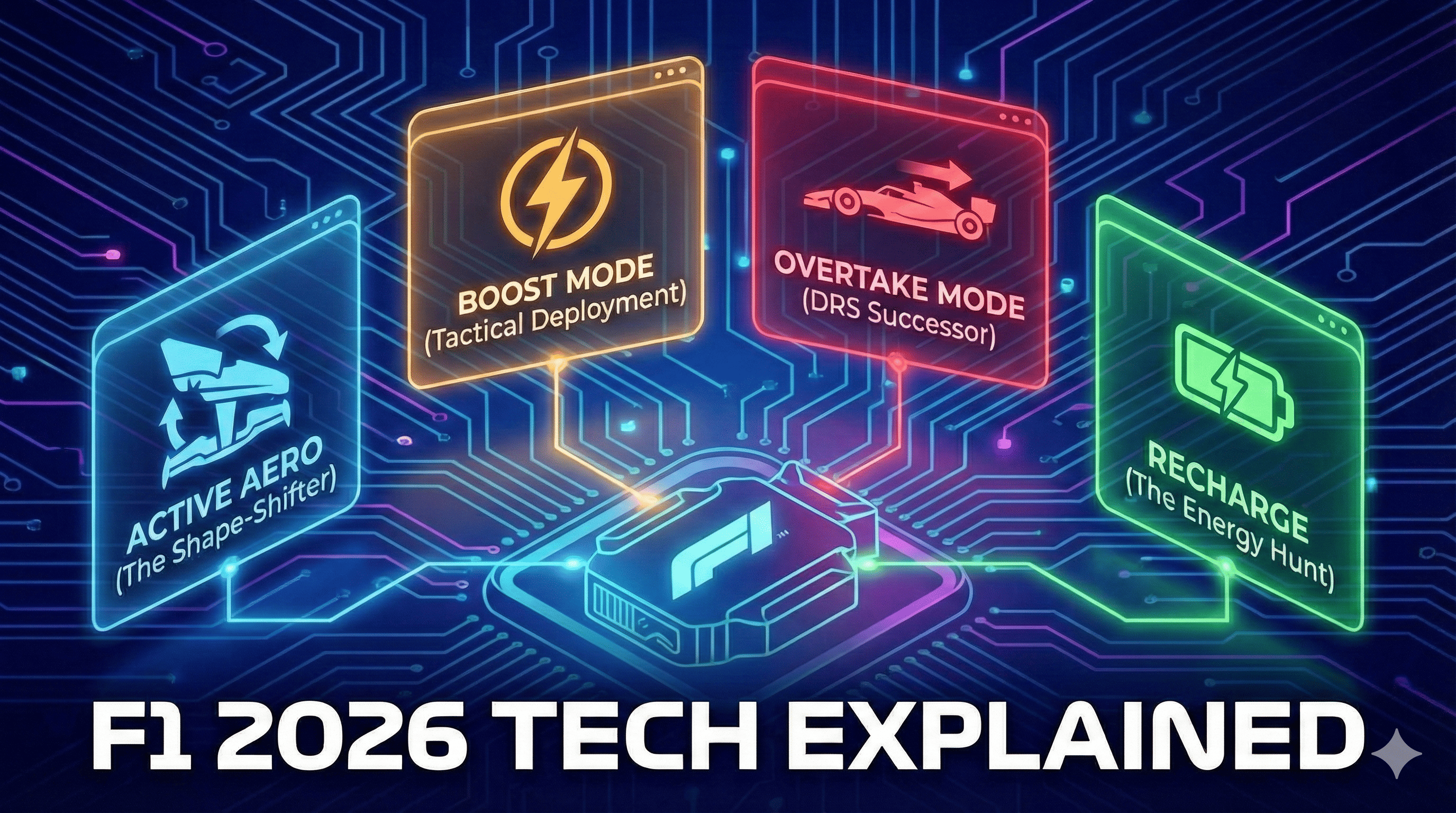
Welcome to Year Zero. The 2026 Formula 1 season hasn't just changed the cars; it has fundamentally rewritten how drivers race them. Gone are the days of simple DRS trains. The new regulations have introduced a suite of active systems that turn energy management and aerodynamic efficiency into a high-speed chess match. F1 has become a resource management game, where drivers must balance raw speed with battery depletion on every single lap.
If you want to understand why a driver suddenly gains three tenths in Sector 2, or why your GridPlay podium pick is suddenly falling back through the field, you need to master the new terminology.
Here is your definitive glossary to the four technical pillars of the 2026 era.
1. Active Aero (The Shape-Shifter)
This is the foundation of the 2026 regulations. The cars are no longer static objects; they physically change shape depending on where they are on the track to maximise efficiency.
- What is it? Moveable flaps on both the front and rear wings that dynamically adjust to balance straight-line speed against cornering grip.
- Activation Trigger: Available to all drivers on every lap in designated high-speed sections. Drivers manually ‘open’ the wings to engage "Straight Mode."
- Advantage: "Straight Mode" flattens, or opens the front and back wing profiles, slashing drag by a massive 40%. This significantly increases top speed on straights.
- Tactical Detail: The system automatically snaps back into "Corner Mode" (high downforce) as soon as the driver brakes or lifts off the throttle. To prevent accidents, there is also a mandatory "lap distance turn-off" to ensure wings close before high-speed corners, preventing drivers from entering dangerous bends with no grip. If drivers lift and coast, the wings close giving potential advantage to the driver behind.
2. Boost Mode (Tactical Deployment)
Think of this as the standard "attack" button. It is the primary tool drivers use to manage their pace, defend a position, or close a gap.
- What is it? A driver-operated system that delivers maximum combined power from the internal combustion engine and the massive new 350kW hybrid battery.
- Activation Trigger: A dedicated Boost Button on the steering wheel that can be pressed anywhere, at any time.
- Advantage: Immediate, on-demand maximum power deployment.
- Tactical Detail: Usage is entirely limited by the current battery charge. A driver can use it all in one massive defensive move on Lap 1, but they will then be vulnerable (a "sitting duck") for several laps while they recharge.
3. Overtake Mode (The DRS Successor)
This is the replacement for the Drag Reduction System (DRS). It is a specific, earned performance aid designed purely to help chasing cars make a pass.
- What is it? A bonus allowance of electrical energy granted only to attacking drivers.
- Activation Trigger: Triggered only when a driver is within 1 second of the car ahead at a single, predefined detection point (usually before the main straight).
- Advantage: The driver is granted an extra +0.5 megajoules (MJ) of energy to deploy on the following lap.
- Tactical Detail: Unlike DRS, which could only be used in specific zones, this extra energy can be deployed anywhere on the next lap. A driver might use it in one big hit on the main straight, or spread it out through technical sections to pressure the car ahead into an error.
4. Recharge (The Energy Hunt)
With electrical power now accounting for nearly 50% of total output, getting energy back into the battery is just as important as spending it.
- What is it? The various methods used to harvest kinetic and heat energy to refill the hybrid battery.
- How it Works: Most harvesting is automated by the car's Electronic Control Unit (ECU), primarily under braking.
- Driver Control: The crucial element drivers control is lift-off regen. By lifting off the throttle early at the end of a straight ("lift and coast"), they recharge the battery faster. However, lifting off automatically disables Active Aero, increasing drag and slowing the car down sooner. This creates a constant strategic trade-off between straight-line speed and battery recovery.
Why This Matters for Your GridPlay Strategy
In the 2026 era, the fastest car won't always win. The winning driver will be the one who best manages these four systems.
When watching practice sessions or analysing race pace for your predictions, look for drivers who are efficient at Recharging without losing too much lap time. A driver who has saved their battery and earned an Overtake Mode activation going into the final three laps holds a massive strategic advantage over a rival running on empty.